Loft Conversions in London: The Complete 2026 Guide to Costs, Planning & Design
Everything you need to know about loft conversions in London in 2026. Dormer, hip-to-gable, mansard and L-shaped options explained with costs, timelines and planning permission guidance.
Loft Conversions in London: What You Need to Know in 2026
A loft conversion is one of the most cost-effective ways to add a bedroom, home office or bathroom to your London home without extending your footprint. In 2026 the rules around permitted development, fire safety and energy efficiency have evolved — here is our up-to-date guide covering every type of loft conversion available to London homeowners. Loft conversions provide exceptional value, typically costing 30-40% less per square metre than ground-floor extensions while adding valuable living space.
Types of Loft Conversion
Rear Dormer Loft Conversion
The rear dormer is the most common loft conversion in London terraced and semi-detached houses. It extends from the rear plane of the roof, creating a flat-roofed box that maximises headroom and floor area. A typical rear dormer in London adds 15-20 square metres of usable space and usually falls within permitted development rights, meaning no planning application is needed. Rear dormers work on almost every terraced property type.
Advantages of rear dormers include: excellent value (lowest cost loft conversion option), permitted development eligibility avoiding planning delays, relatively quick installation (6-8 weeks), and minimal disruption to daily life since work is primarily external. Disadvantages are: only adds one room of reasonable size, rear dormers are only visible from the rear/garden (not street-facing), and they require structural reinforcement of the existing roof.
L-Shaped Dormer Loft Conversion
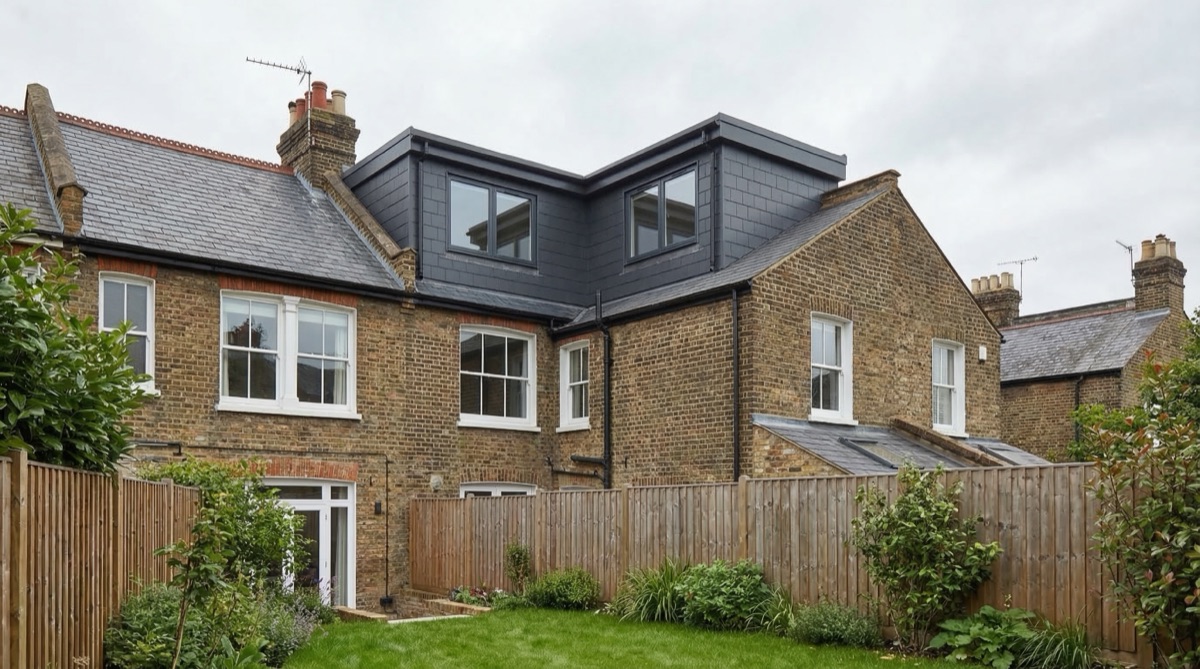
An L-shaped dormer combines a rear dormer with a side dormer to create even more space, particularly on Victorian and Edwardian terraced houses with a rear outrigger. This design is popular in areas like Walthamstow, Tooting and Peckham where period terraces have a distinctive L-shaped footprint at roof level. L-shaped conversions create 20-25 square metres of usable space, substantially more than rear dormers alone.
L-shaped dormers provide more space but involve planning permission (side dormers affect street appearance), higher cost (approximately £10,000-15,000 more than rear dormer), and longer build time (10-12 weeks). However, the additional space often justifies these drawbacks.
Hip-to-Gable Loft Conversion
Semi-detached and detached houses often have a hipped roof that slopes inward on one or both sides. A hip-to-gable conversion extends the hip to a vertical gable wall, significantly increasing the volume of usable space in the loft. This option is popular in suburban areas such as Barnet, Enfield, Southgate and Chiswick where 1930s and post-war semis with hip roofs are common. Hip-to-gable conversions typically add 18-25 square metres.
Hip-to-gable conversions offer excellent space efficiency but require planning permission (visible gable ends affect property appearance), moderate cost (£55,000-75,000), and 8-10 week timelines. They're ideal where rear dormers alone wouldn't provide adequate space.
Mansard Loft Conversion
A mansard conversion replaces the rear roof slope with a near-vertical wall and a flat top, creating the maximum possible space. Mansard conversions almost always require planning permission and are commonly used in conservation areas across London where the design can be made sympathetic to the existing streetscape. Mansard conversions are most popular in central London properties where every square metre of space is valuable.
Mansards maximize space (25-35 square metres typical) and create flexible interiors but require planning permission, involve substantial cost (£65,000-90,000+), longer timelines (12-14 weeks), and more complex structural work. They suit properties where maximum space justifies the complexity.
How Much Does a Loft Conversion Cost in London?
Loft conversion costs in London vary depending on the type of conversion, the size of the property, and the specification of finishes. As a rough guide for 2026:
Rear dormer: £45,000 to £65,000 including a bedroom and en-suite bathroom with standard finishes and good insulation.
L-shaped dormer: £55,000 to £75,000 adding the side dormer element, with equivalent specifications to rear dormer.
Hip-to-gable with rear dormer: £55,000 to £80,000 depending on the structural work required for the conversion.
Mansard: £65,000 to £90,000 or more due to the complexity of the structural and planning requirements.
These figures include design, structural engineering, building regulations approvals, and construction costs including a good quality kitchen and bathroom. Additional costs may apply for high-end finishes, bespoke joinery, or particularly complex structural situations such as metal roof structures requiring specialist engineering.
Do You Need Planning Permission?
Most rear dormer and hip-to-gable loft conversions in London fall under permitted development rights, meaning no planning application is required. However, you must still comply with building regulations and submit applications for building control approval. You will need planning permission if your property is in a conservation area, if you are proposing a mansard conversion, if the property is a flat or maisonette, or if you have already used your permitted development allowance on previous extensions. The Party Wall Act applies to all loft conversions on terraced or semi-detached properties, requiring surveyor involvement.
The Loft Conversion Process Step-by-Step
Step 1: Free Consultation and Structural Survey
We visit your property to assess the existing roof structure, measure headroom, check for obstructions like water tanks or chimney stacks, and discuss your requirements. This visit is completely free and there is no obligation to proceed. The structural survey identifies the conversion type best suited to your property and roof structure.
Step 2: Design and Structural Drawings
Our architectural team produces detailed design drawings showing the proposed layout, including bedroom, bathroom, staircase position and storage. We also prepare structural engineering calculations and building regulations drawings. Designs maximize space while ensuring building regulations compliance for fire safety, insulation, and ventilation.
Step 3: Party Wall and Planning (If Required)
We handle all party wall notices required for terraced or semi-detached properties and submit planning applications if required. We manage the entire approval process on your behalf, addressing any planning officer concerns and negotiating conditions.
Step 4: Building Regulations Approval
Building regulations approval ensures structural safety, adequate insulation and ventilation, fire safety provisions, and electrical safety. Building control inspections occur at key stages of construction to verify compliance.
Step 5: Construction
A typical loft conversion takes 8 to 12 weeks to build. The work is carried out from scaffolding on the outside of the property, so disruption to your daily life is kept to a minimum. Most families continue living in the property throughout the build.
Loft Conversions by Area
We carry out loft conversions across London and the surrounding areas. Each area has its own planning policies and property types that influence the best approach:
South London — Tooting, Carshalton, Wallington, Morden, Peckham and Mitcham all have large numbers of Victorian and Edwardian terraces perfectly suited to dormer and L-shaped conversions.
North London — Enfield, Southgate, Winchmore Hill, Barnet and Walthamstow feature a mix of period terraces and 1930s semis ideal for hip-to-gable and rear dormer combinations.
East London — Chadwell Heath, Barking, and surrounding areas offer excellent opportunities for loft conversions on both terraced and semi-detached properties.
Building Regulations and Fire Safety Requirements
All London loft conversions must comply with current building regulations, which have become increasingly stringent around fire safety and thermal performance. Modern building regulations require fire-resistant materials where the loft room adjoins other parts of the building, proper escape routes with acceptable window sizes if bedrooms are created, and interconnected fire alarms throughout the property. Additionally, insulation standards (U-values around 0.15 W/m²K) ensure the loft room remains warm in winter and cool in summer. Mechanical ventilation with heat recovery is often required to maintain air quality while preserving thermal performance. These requirements add cost but ensure the loft room is genuinely habitable year-round and safe in case of emergency.
The Value of Loft Conversions in London
Investment in a loft conversion represents exceptional value in the London property market. A typical £60,000 loft conversion can increase property value by £85,000-100,000, representing a net gain of £25,000-40,000. This value increase reflects the high cost of acquiring additional bedrooms in London through purchase of a larger property — a smaller house might sell for £100,000 less simply due to having one fewer bedroom. The ability to add a bedroom for £60,000 rather than paying £100,000-150,000 for a larger property makes loft conversions one of the best-value home improvements available. Additionally, the loft room improves daily living in ways that transcend financial calculation: creating a dedicated bedroom for a growing child, a home office, or a guest bedroom fundamentally improves quality of life.
Why Choose Home Extensions Now for Your Loft Conversion?
We specialise in loft conversions across London with a team that understands local planning policies, building regulations and the structural characteristics of London housing stock. We offer a complete service from initial consultation through design, planning, building regulations and project management to completion. Contact us today for a free consultation and quote for your loft conversion project. Call 020 3051 9430 or request a quote online.
Explore More House Extension Design Options
Related Articles
Comprehensive guide to house extension planning permission in 2024. Learn about costs, timelines, planning applications, and what to expect from professional house extension specialists.
Discover the key advantages of choosing professional house extension services. From cost savings to creative solutions, learn why specialists are essential for successful projects.
Complete guide to house extension costs in the UK. Learn about fee structures, budgeting tips, and how to get maximum value from your house extension investment.
Ready to Get Started?
Home Extensions Now Team
Our expert team of architectural design specialists brings decades of combined experience in UK house extension design and planning services for residential and commercial projects. We're committed to providing clear, actionable insights to help you make informed decisions about your home extension projects.
Ready to Plan Your Home Extension?
Whether you're planning a single-storey extension, renovation project, or complete home redesign, our house extension design solutions can help you build quickly and confidently.